
Blog title heading will go here

A Smile for David
By Alessandro Michelucci Musica Maestro — 17 October 2026
There are increasingly more European composers connected to New Zealand. John Psathas, born in this archipelago to Greek immigrants, has not forgotten his Hellenic roots, as demonstrated by View from Olympus (2002) and The New Zeibekiko (2010).
The Greek pianist Tania Giannouli records for the Rattle label (Rewa, 2018; In Fading Light, 2020, etc.). The same label has recently released a CD by Roberto Fabbriciani (Fleuno, 2026), principal flautist of the Maggio Musicale Fiorentino Orchestra, and one by the young pianist Flavio Villani, In Memoriam (2026), who lives in Auckland.
The latter, born in 1984 in Nocera Superiore (Salerno), studied under the guidance of pianist Matteo Napoli and graduated in piano from the “Giuseppe Martucci” Conservatory in Salerno. After spending several years in Spain, he decided to move to New Zealand to teach at the Vivaldi Academy of Music, the school founded by Matteo Napoli, who had meanwhile settled in that distant archipelago.
The documentary Crossing Rachmaninoff (2015), directed by Rebecca Tansley, recounts Villani's journey from Italy to New Zealand, interweaving it with the psychological implications connected to his relationship with music.
In the following years, the musician worked extensively as a soloist. He obtained a Master's degree in piano performance at the University of Auckland, studying under Stephen De Pledge. He has maintained an active concert career, performing with various ensembles and numerous orchestras, with whom he has also performed compositions by Addinsell, Mozart, Rachmaninoff and other composers.
At the same time, by now having achieved considerable professional growth, he began to compose.
As mentioned above, the pianist recently made his recording debut with In Memoriam (Rattle, 2026), dedicated to his partner David McDonald, who passed away prematurely in 2024.
As one can imagine, making this album involved him profoundly, but it also had a cathartic effect: “Grief was the reason I began this album. But I believe that, in the end, it became a work about memory,” he himself said.
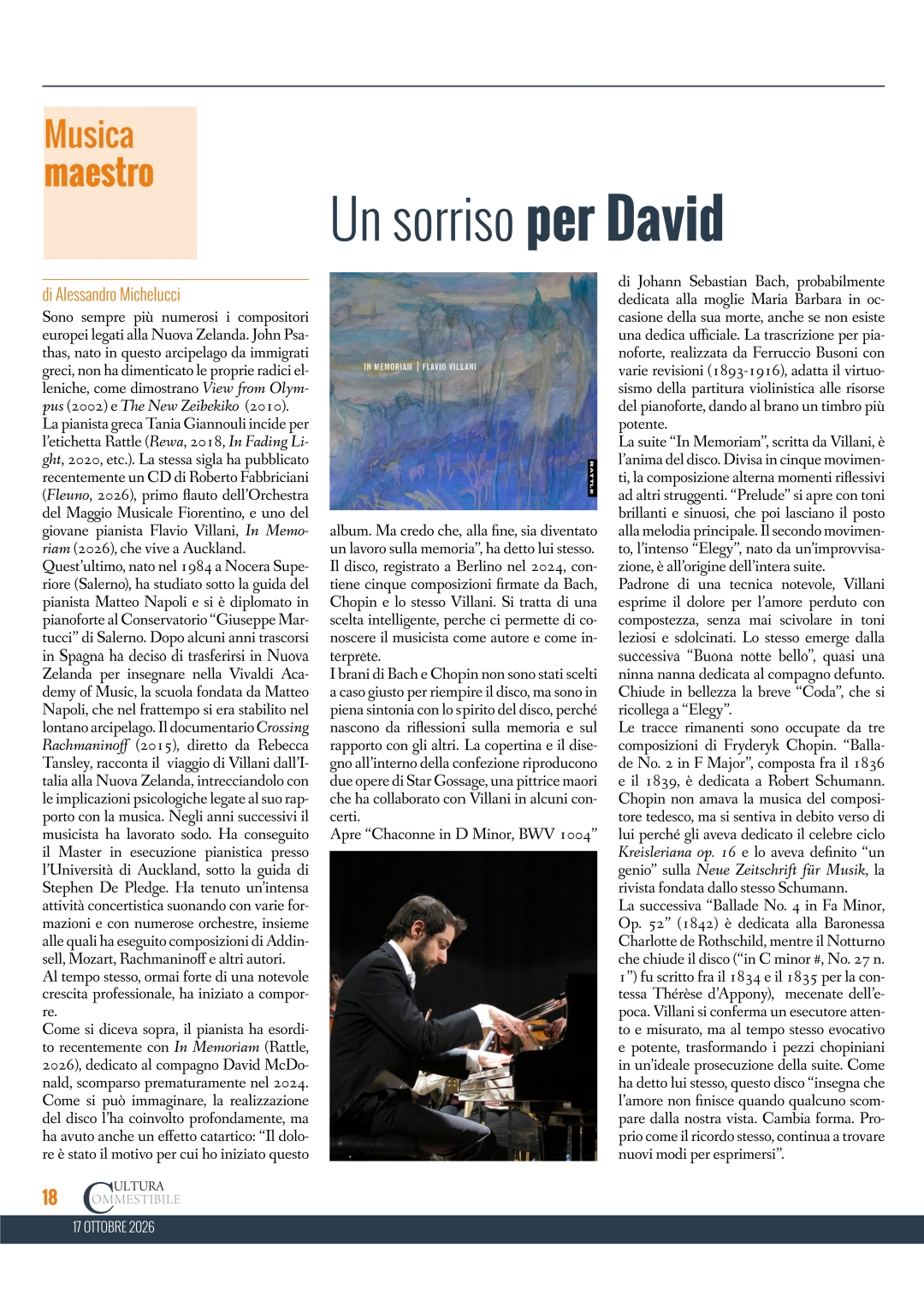
The album, recorded in Berlin in 2024, contains five compositions by Bach, Chopin and Villani himself. It is an intelligent choice, allowing us to discover the musician both as a composer and as an interpreter.
The pieces by Bach and Chopin were not chosen at random merely to fill out the album, but rather in complete harmony with its spirit, because they arise from reflections on memory and on our relationship with others. The cover and the design inside the CD packaging reproduce two works by Star Gossage, a Māori painter who has collaborated with Villani on several occasions.
The album opens with the Chaconne in D minor, BWV 1004, by Johann Sebastian Bach, probably dedicated to his wife Maria Barbara on the occasion of her death, although no official dedication exists. Ferruccio Busoni's piano transcription, produced through several revisions (1893–1916), adapts the virtuosity of the violin score to the resources of the piano, giving the piece a more powerful sonority.
The In Memoriam suite, written by Villani, is the heart of the album. Divided into five movements, the composition alternates reflective moments with others that are more poignant.
The "Prelude" opens with brilliant, resonant tones, which then give way to the main melody. The second movement, the intense "Elegy", was born from an improvisation and is the origin of the entire suite.
Possessing a remarkable technique, Villani expresses the pain of lost love with composure, never slipping into mawkish or sentimental tones. The same quality emerges from the following "Buona notte, bello", almost a lullaby dedicated to his late partner. The brief "Coda", which reconnects with the "Elegy", closes the suite beautifully.
The remaining tracks consist of three compositions by Fryderyk Chopin.
The Ballade No. 2 in F major, composed between 1836 and 1839, is dedicated to Robert Schumann. Chopin did not love the music of the German composer, but felt indebted to him because Schumann had dedicated the celebrated piano cycle Kreisleriana, Op. 16, to him, and had described him as “a genius” in the Neue Zeitschrift für Musik, the journal founded by Schumann himself.
The following Ballade No. 4 in F minor, Op. 52 (1842), is dedicated to Baroness Charlotte de Rothschild, while the Nocturne that closes the album (in C-sharp minor, No. 2 of Op. 27) was written between 1834 and 1835 for Countess Thérèse d'Appony, a patron of the arts at the time.
Villani confirms himself as an attentive and measured performer, yet at the same time evocative and powerful, transforming Chopin's pieces into an ideal continuation of the suite.
As he himself has said, this album “teaches that love does not end when someone disappears from our sight. It changes form. Just like memory itself, it continues to find new ways of expressing itself.”
[Translated from the original Italian review by Alessandro Michelucci, with the aim of preserving its tone and meaning while allowing the English to read naturally.
Two small biographical clarifications: Flavio Villani grew up in Nocera Superiore before moving to Spain, but was not born there. His subsequent move to New Zealand was initially to take up a teaching position at a small music school in Kerikeri, then directed by Matteo Napoli.]
